Winding Along the Tagus: A Tour Between Two Riverbanks - A motorcycle journey organized and lived with 2Ride Portugal, in the person of Sérgio Lopes - Chapter 3 of 5
Eleven Bridges Later, the Return Begins
In the previous chapters, we crossed the Tagus eleven times — from Lisbon to Marvão, and from Marvão to Abrantes by way of Spain, on the most intense day of the whole trip. This chapter marks the start of the road back, taking us past an island with a Templar castle, through a village famous nationwide for its horses, and over one of the most imposing bridges we crossed on the entire journey.
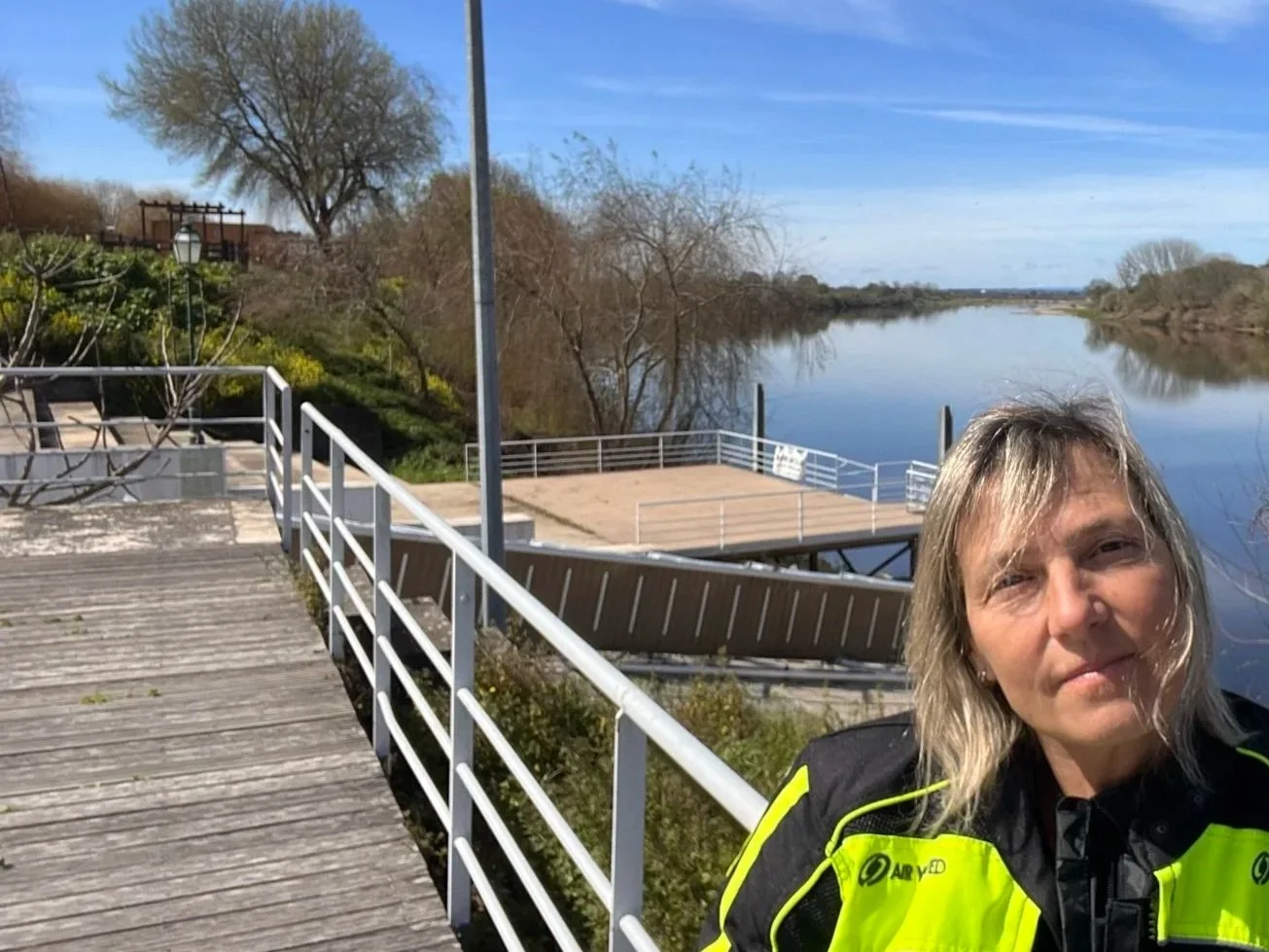
selfie time by the Tagus river across Vila Nova da Barquinha
An Island, a Castle, Knights in Armor
Once again we crossed the river, this time over the Abrantes bridge, opened in 1870, its deck widened not long before the bridge turned a hundred years old. The road hugs one of the riverbanks all the way to Constância, absolutely stunning, with curves that carry us through what feels like a painting, sunlight glinting off the water, the banks tracing the river's own winding motion.
Entering Constância, we crossed the Praia do Ribatejo Bridge, opened in 1889 as a purely railway bridge. Due to the poor state of the structure, a new one was built over the same pillars in 1959, later adapted for road traffic and reopened in 1988. Constância is a lovely, welcoming village, with a river beach stretching over a wide expanse of sand, where the Zêzere weaves into the Tagus — I couldn't resist putting my feet straight in the water, which looked far too inviting to pass up.
Continuing on to Almourol Castle, which to me is the definitive icon among Portugal's castles, perched on a rocky island in the middle of the Tagus, and perhaps the site that best evokes the memory of the Templars in our country. We were able to reach the island and climb up to the walls — standing at that high point, surrounded by river on every side, feels like being carried back to an age of knights in full armor.
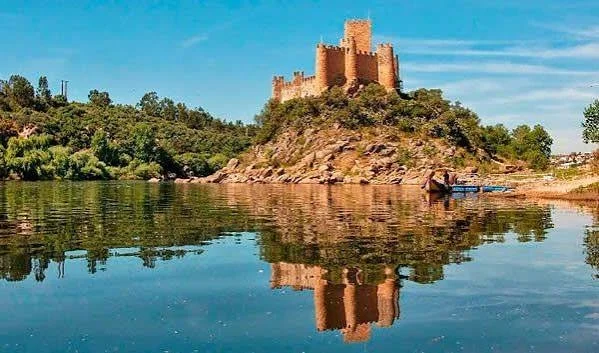
Almourol Castle
The Princess of the Tagus Wears Horseshoes
We continued on, passing through Vila Nova da Barquinha, known as the "princess of the Tagus," since this region forms part of the Grande Rota dos 3 Rios, linking the Tagus, the Zêzere, and the Nabão. Back on the road, a little further from the river now, we reached Golegã, which, among many other points of interest, is famous for the National Horse Fair held every November, complete with horse parades, carriages, traditional riding costumes — and, of course, plenty of água-pé and roasted chestnuts.
We moved on to another Tagus crossing, this time over the João Joaquim Isidro dos Reis Bridge, better known as the Chamusca Iron Bridge, linking the towns of Chamusca and Golegã. This structure is a textbook example of iron construction, a technique very much in fashion at the turn of the 20th century. Originally planned, in 1900, to be a railway bridge — part of a rail branch line from Torres Novas to Golegã that was never actually built — it ended up being erected as a road and pedestrian bridge instead, with construction starting in 1908 and the bridge opening on August 31, 1909.
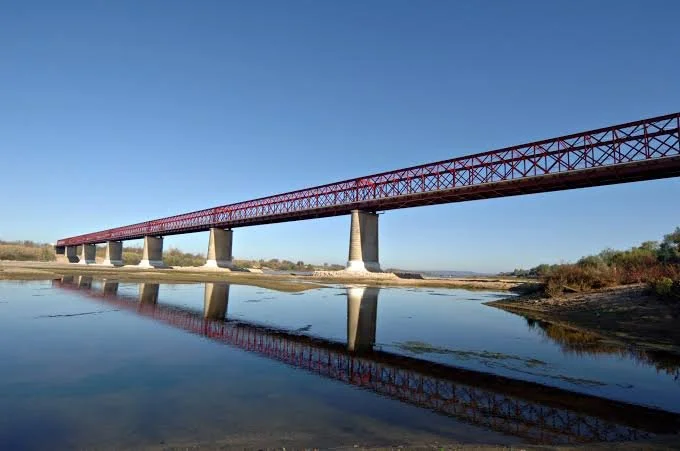
Joaquim Isidro dos Reis Bridge (a.k.a. Chamusca iron brigde) - 1909
The Bridge That Was Once (Almost) the Biggest in the World
With Chamusca disappearing in the rearview mirror, the road curves back toward the river to carry us into Santarém, and it's there that the Tagus takes on an almost solemn breadth, as if it already knew what was coming: the D. Luís I Bridge, also known as the Santarém Bridge, linking Santarém to Almeirim along the EN 114. It opened on September 17, 1881, and was, at the time, considered the largest bridge on the Iberian Peninsula, the third largest in Europe, and the sixth in the world — one of the great examples of "iron architecture." It originally measured 1,213 meters in total length, 6 meters in width, and 22 meters in height, and was widened in 1956.
Crossing it on the bike, feeling the narrow deck beneath the wheels, feels like unknowingly repeating a gesture made by countless generations before us — there's something reassuring in that continuity, something only century-old bridges seem able to give.
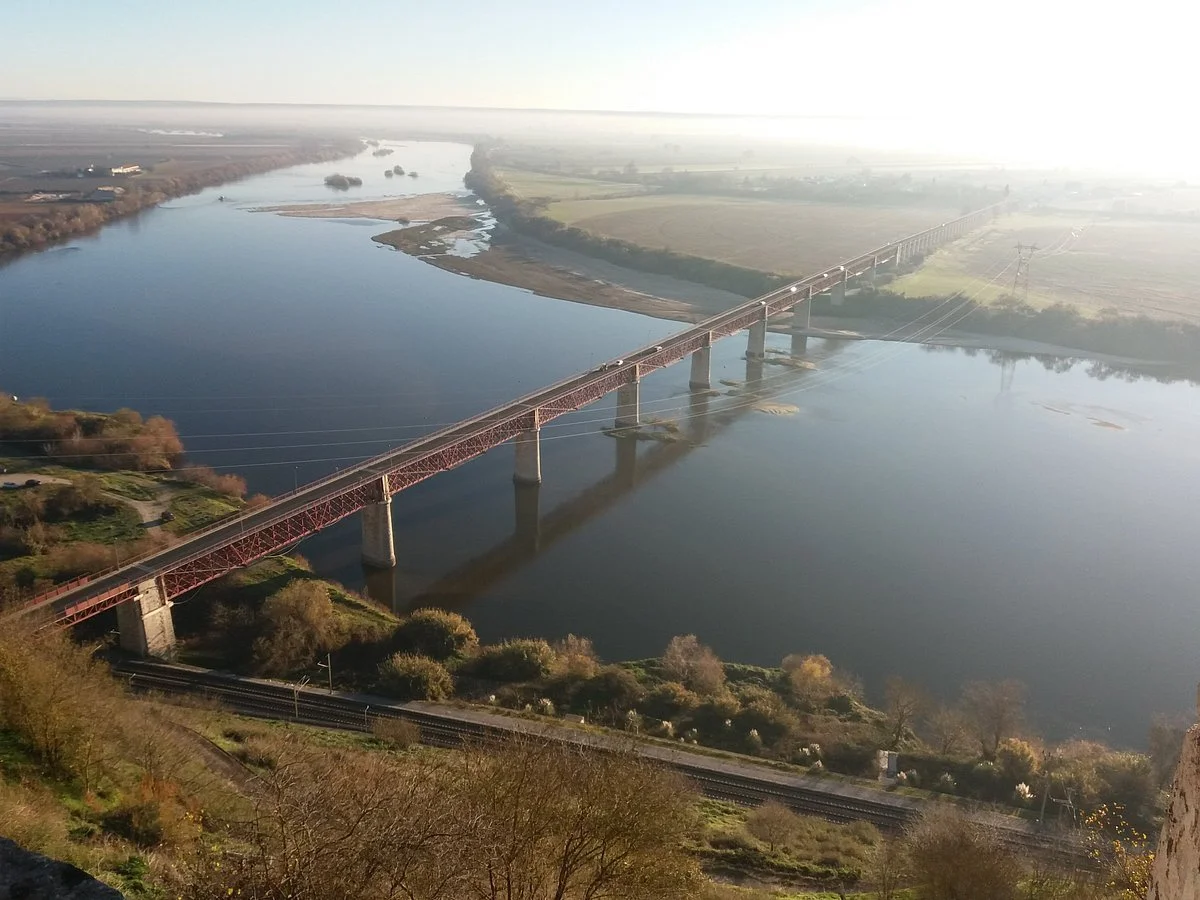
D. Luís I Bridge, Santarém-Almeirim (1881)
Tomorrow, an Unlit Bridge
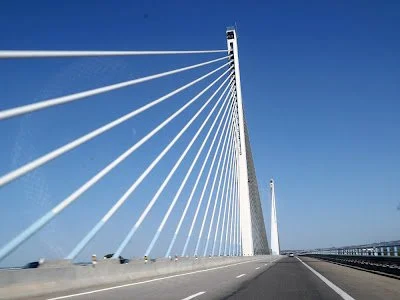
Already on the road back home, we still had the Lezíria do Tejo to cross — a Portuguese sub-region of flood-prone lowlands, extremely fertile for rice farming, with Santarém as its most important town. And it was there, in that wide-open green expanse, that one of the most modern crossings of the whole trip was waiting for us: a bridge so recent its engineers decided not to give it any lighting at all, so as not to disturb the planes flying overhead.